
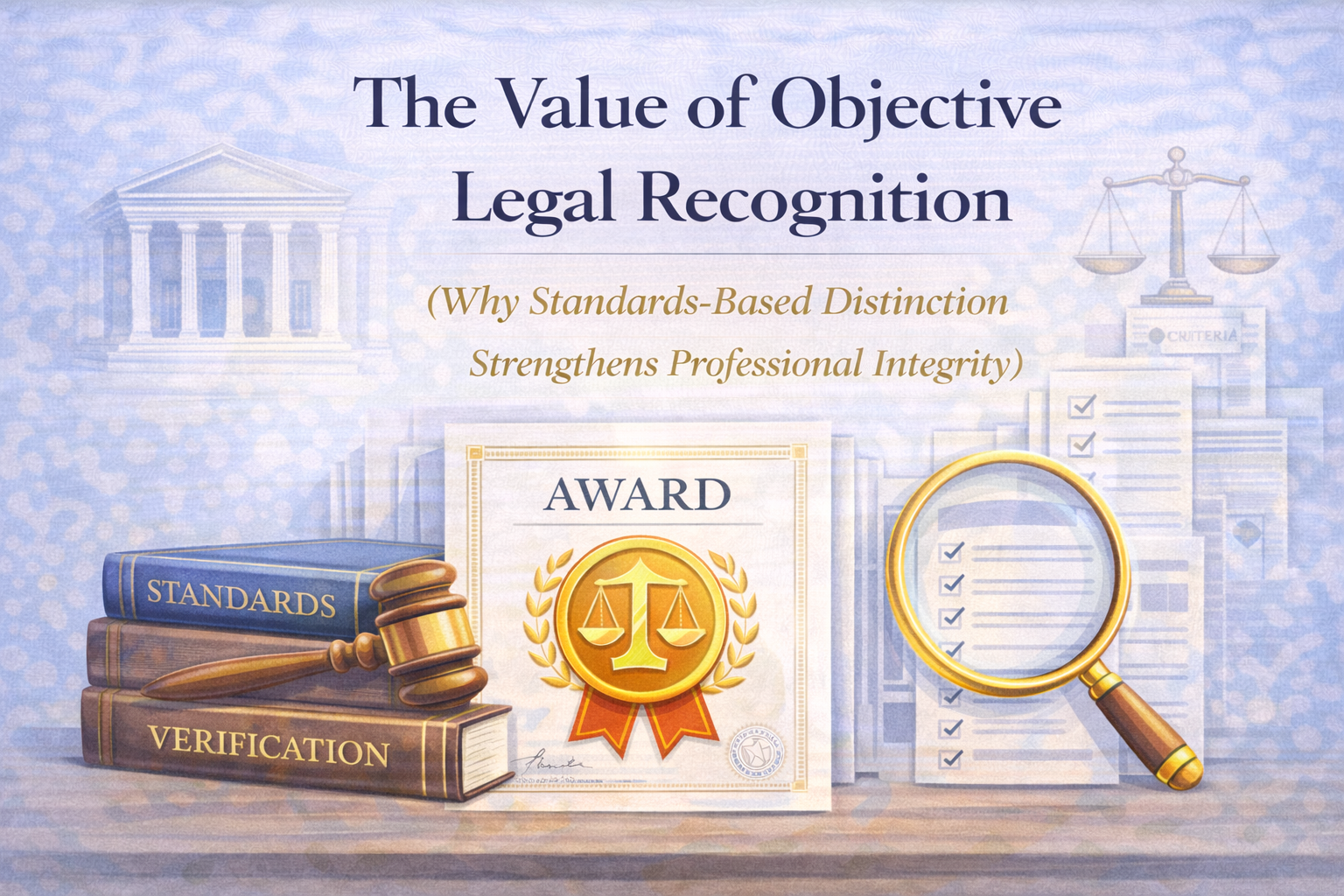
(Why Standards-Based Distinction Strengthens Professional Integrity)
Professional recognition has long played a role in the legal profession. Awards and distinctions are intended to signal experience, achievement, and credibility.
However, recognition only retains value when it is grounded in objective standards.
Objective legal recognition is not about visibility, marketing, or prestige branding. It is about measurable achievement evaluated under transparent criteria. Without structure and verification, professional distinction risks becoming indistinguishable from promotion.
Understanding the value of objective recognition is essential for preserving trust in legal credentials.
Objective legal recognition is based on:
Clearly defined eligibility criteria
Measurable performance benchmarks
Structured evaluation processes
Independent documentation review
Public verification capability
It is recognition earned through demonstrable achievement rather than participation.
The key distinction is that objective recognition applies standards consistently and transparently.
The legal profession depends on public confidence. Clients often rely on credentials when selecting representation.
If recognition programs lack measurable standards, the meaning of distinction becomes unclear.
Objectivity ensures that:
Recognition reflects documented performance
Standards are applied consistently
Titles carry measurable significance
Clients can evaluate credentials with confidence
When recognition is objective, it reinforces credibility rather than undermining it.
Achievement-based recognition protects the integrity of professional distinction.
Without objective standards:
Recognition may become transactional
Designations may blur into marketing tools
Public trust may diminish
Professional titles may lose meaning
Objective evaluation preserves the distinction between earned accomplishment and promotional placement.
Recognition must remain tied to measurable performance.
Objectivity is strengthened by transparency.
Credible programs publish:
Eligibility criteria
Review methodologies
Documentation requirements
Verification systems
Transparency allows recognition to be examined rather than simply displayed.
When credentials are verifiable, they maintain institutional credibility.
Verification is the final safeguard of objective recognition.
A publicly accessible directory or confirmation system ensures that:
Recognition status can be independently confirmed
Award categories are clearly identified
Recognition years are documented
Status remains current and transparent
Verification transforms recognition from a claim into a confirmable credential.
Trust is central to legal practice.
Clients entrust attorneys with significant personal, financial, and legal matters. Recognition programs should reinforce that trust — not complicate it.
Objective legal recognition:
Encourages measurable performance
Promotes transparency
Distinguishes merit from marketing
Strengthens institutional credibility
When standards are clear and consistently applied, recognition retains meaning.
The value of legal recognition depends on its foundation.
Objective legal recognition is defined by:
Measurable benchmarks
Transparent evaluation
Documentation-based review
Public verification
Consistent standards
When recognition is proven rather than purchased, it strengthens professional integrity and preserves public trust.
Without objectivity, distinction becomes diluted.
With objective standards, recognition retains its intended significance.