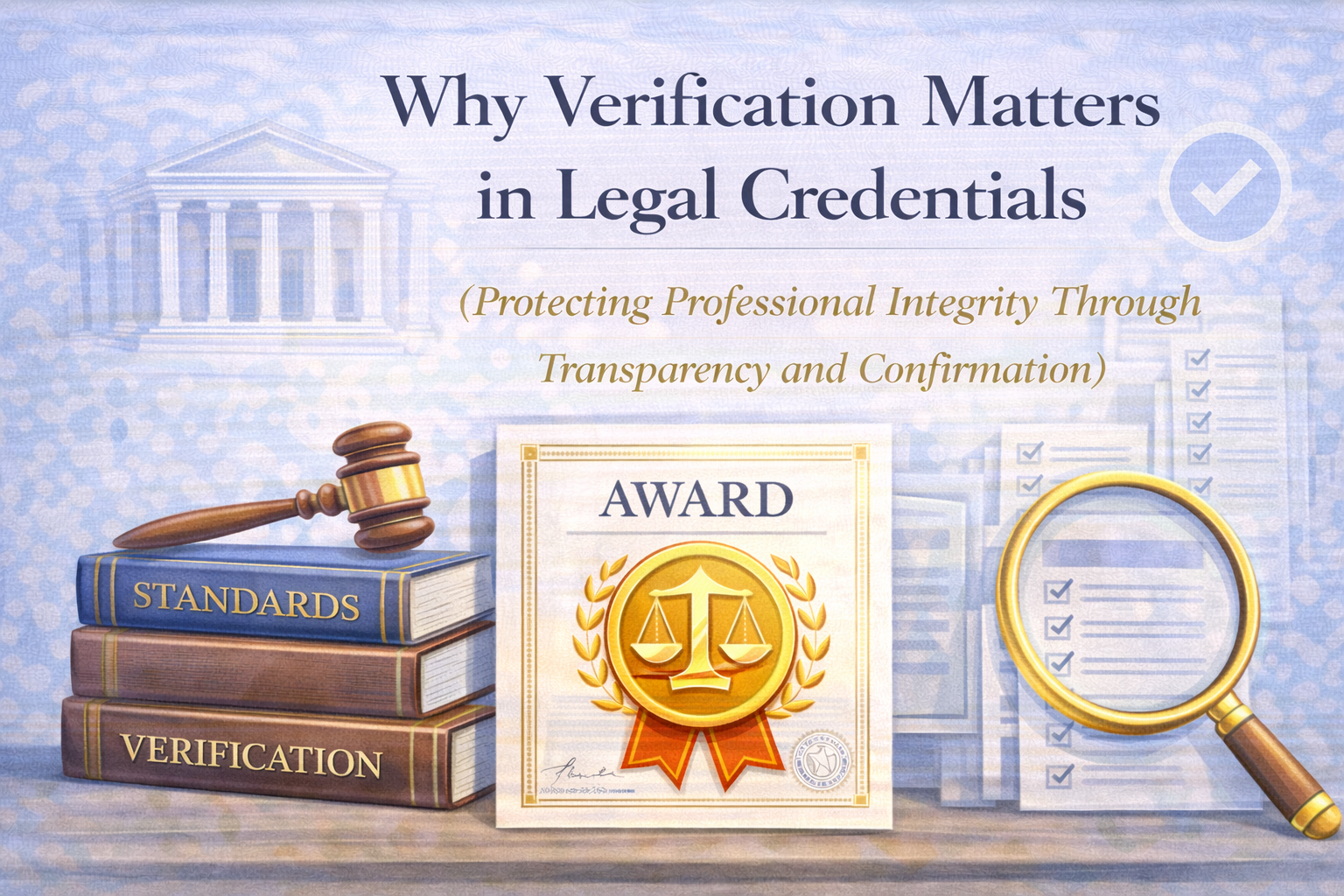
(Protecting Professional Integrity Through Transparency and Confirmation)
Legal credentials influence important decisions.
Clients rely on professional distinctions when selecting representation. Institutions reference recognitions when assessing credibility. Attorneys display awards to demonstrate achievement.
But recognition without verification is merely a claim.
Verification transforms recognition from a marketing statement into a confirmed credential. In a professional field built on trust and accountability, verification is not optional — it is essential.
Many legal awards are displayed as badges, seals, or designations on websites and marketing materials. However, without an independent confirmation system, it can be difficult to determine:
Whether recognition was earned under defined standards
Whether it is current
What specific achievement it represents
Whether the designation is legitimate
Verification bridges the gap between display and confirmation.
It ensures that recognition is not only visible — but validated.
The legal profession depends on public trust.
When awards are verifiable:
Clients can independently confirm recognition status
Institutions can assess credentials objectively
Professional distinction retains credibility
Misrepresentation is reduced
Without verification, recognition risks becoming indistinguishable from promotional language.
Verification protects both attorneys and the public.
Verification works hand-in-hand with objective evaluation.
Recognition based on measurable benchmarks should be:
Documented
Recorded
Confirmable
A structured verification system reinforces that:
Standards were applied
Criteria were met
Recognition was earned under defined conditions
Verification ensures that recognition reflects achievement — not assumption.
Transparency is central to professional legitimacy.
A verifiable credential demonstrates that:
The awarding body stands behind its standards
Recognition can be independently reviewed
Status is maintained through recordkeeping
Designations are not arbitrarily granted
When verification is available, recognition carries institutional weight rather than promotional appearance.
Without verification systems:
Credentials may be difficult to confirm
Recognition status may be unclear
Public understanding may be limited
The value of legitimate awards may be diluted
Verification prevents ambiguity.
It creates clarity in a space where titles alone may not provide context.
At its core, verification serves one purpose: safeguarding integrity.
It ensures that:
Recognition is accurate
Standards remain meaningful
Professional distinction retains substance
Public trust is preserved
Verification is not merely administrative — it is foundational to maintaining credibility in legal recognition programs.
Legal credentials influence perception.
Verification ensures that perception aligns with documented reality.
When recognition is:
Earned under objective standards
Transparently evaluated
Publicly confirmable
It strengthens professional credibility and protects institutional integrity.
In a profession defined by accountability, verification matters because truth matters.
Recognition should not only be displayed.
It should be confirmed.